




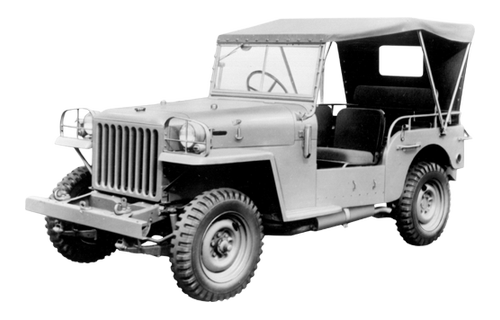

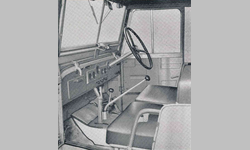

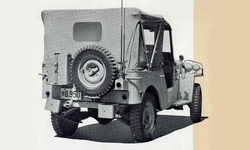




| Grade | Toyota BJ | |
|---|---|---|
| Model type & weight |
Model type | BJ |
| Curb mass(kg) | 1425 | |
| Dimensions | Length(mm) | 3793 |
| Width(mm) | 1575 | |
| Height(mm) | 1900 | |
| Wheelbase(mm) | 2400 | |
| Engine | Engine code | B |
| Engine type | In-line 6-cylinder, OHV | |
| Displacement(cm3) | 3386 | |
| Max. output kW(PS)/r.p.m. | -/85/3200 |
| * | The specifications are those of representative model grades. |
| * | Max. output represents a net rating. In the above table, digits separated by slashes ( / / ) stand for kW, PS, and r.p.m., respectively. |
| * | The model numbers of these vehicles are BJ(3400). |
| Plant | Koromo plant(now Honsha plant) |
|---|
The meaning is the same as in English.



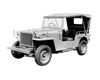
Although the Toyota Jeep BJ's large-displacement engine assured its superiority performance, the National Police Reserve ended up choosing the Mitsubishi Jeep (a licensed production version of the North American Willys Jeep) because the latter had a more extensive track record. Accordingly, the Toyota Jeep was converted for civilian use and went into volume production in 1953.
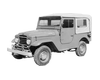
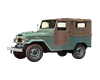
As the Jeep name was a trade mark of Willys-Overland Motors, Toyota changed the vehicle name to the Land Cruiser in June 1954.